What's the Difference Between a String Orchestra and a Full Orchestra?
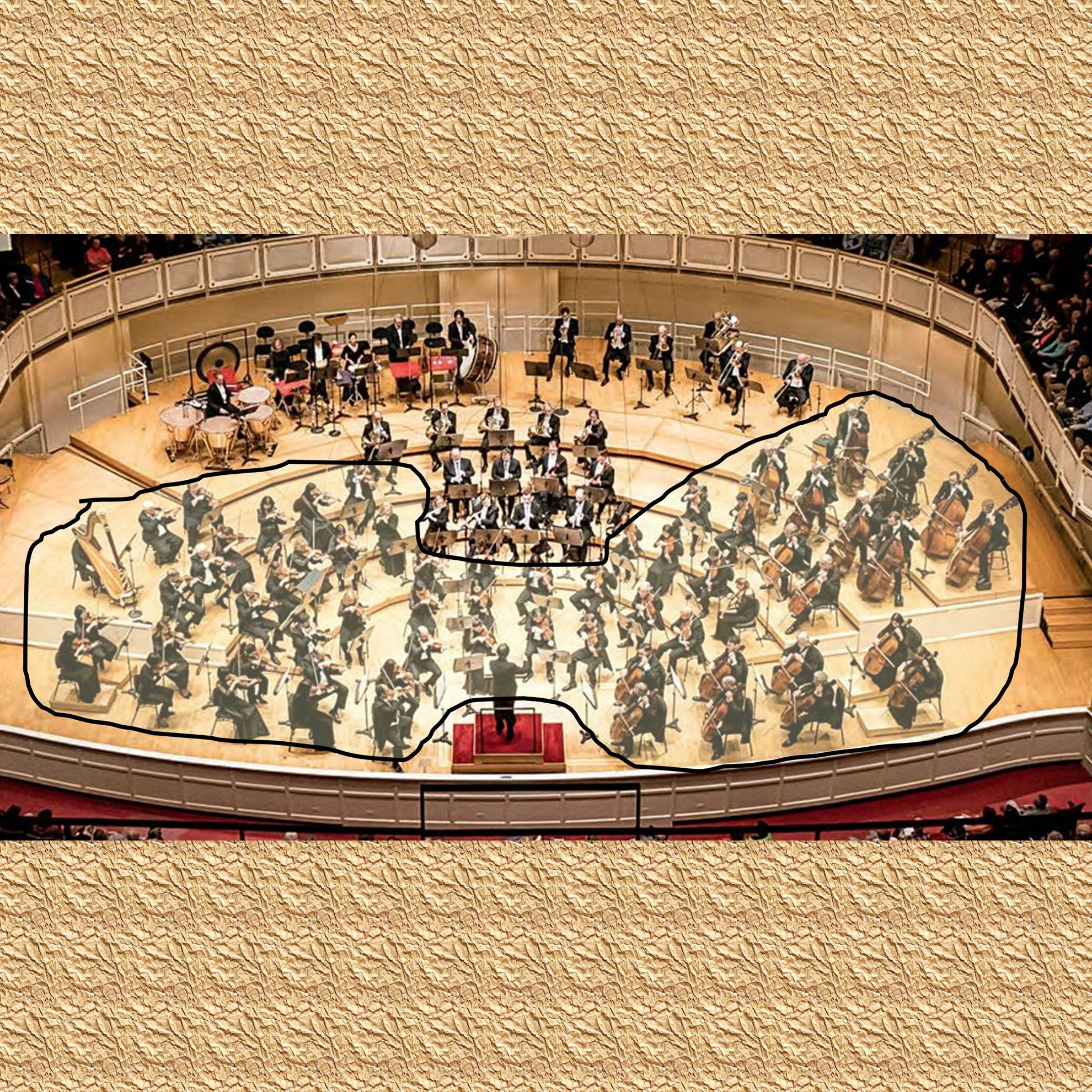
Music has a way of touching our hearts, and one of the most beautiful ways it does so is through orchestras. However, not all orchestras are the same. Two common types are the string orchestra and the full orchestra. While both produce wonderful music, they have important differences in size, instruments, and the types of music they play.
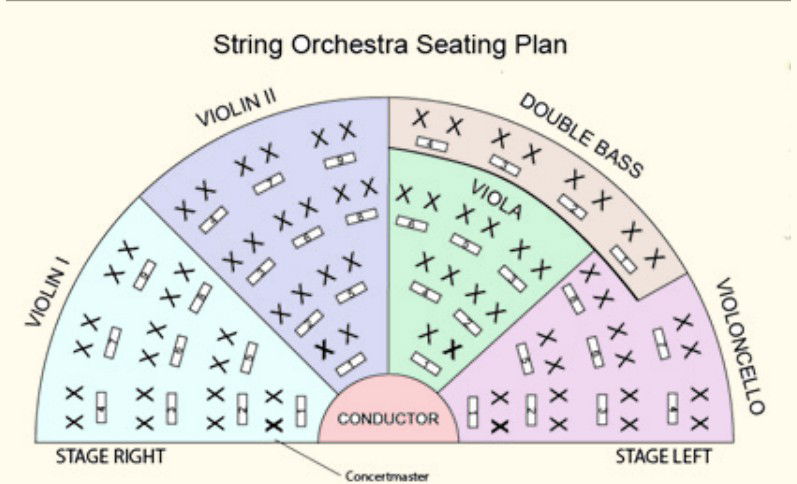
What is a String Orchestra? A string orchestra generally consists only of string instruments. These include:
- Violins – Usually divided into first and second violins, playing different parts. Sometimes those parts are divided even more.
- Violas – Slightly larger than violins, producing a deeper sound. Occasionally, those parts are divided.
- Cellos – Played sitting down, giving a rich, warm tone. Only rarely are cello parts divided.
- Double Basses – The largest of the string instruments, adding a deep, resonant sound. The only division in a double bass part would be if the part were written in octaves to bolster the sound. Any other means of division would usually lead to a muddy sound.
Some String Orchestras don’t have double basses, Sometimes it’s because of lack of availability, particularly in schools with a limited budget for instruments. It may also be a storage or transportation issue. In any case, it’s possible to substitute cellos for the bass part, if the music is written well to accommodate such a situation. - Other Incidental Instruments – Pianos, celestas, and harps have been included by some composers. Sometimes, the music calls for another type of instrument to play, either as a concerto or to add a unique color to the piece.
Since all instruments in a string orchestra belong to the same family, the music has a smooth and blended quality. Composers like Antonio Vivaldi and Johann Sebastian Bach wrote famous pieces for string orchestras. Mozart wrote Serenades for Strings. More contemporary composers like Vaughn-Williams, Tippet, and Britten have all composed for String Orchestra. This type of orchestra has been favored by quite a large number of film and TV composers because if its intimate sound and possibilities for generous, arching melodic phrases.
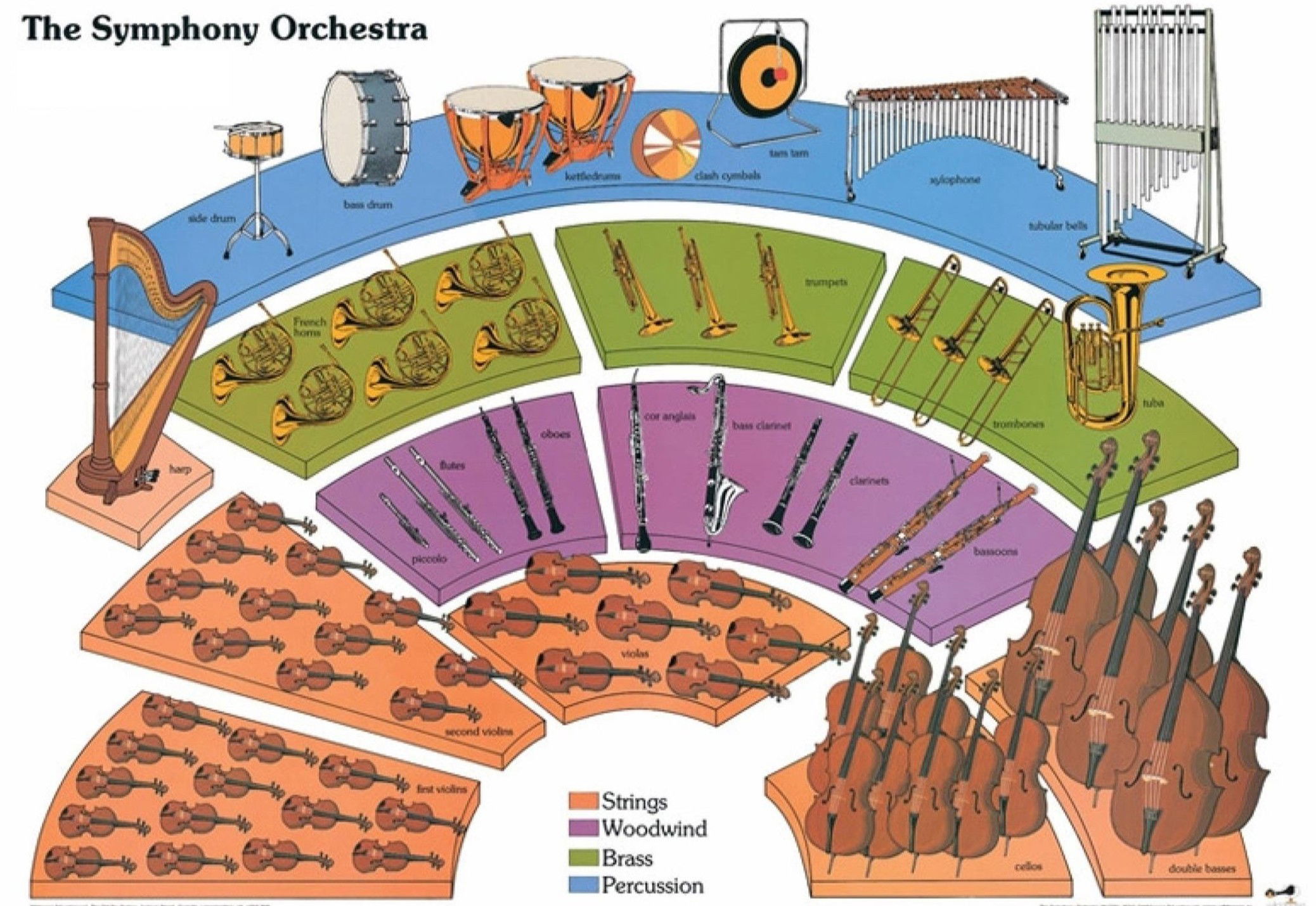
What is a Full Orchestra? A full orchestra, also called a symphony orchestra, includes not only strings but also woodwinds, brass, and percussion instruments. It is much larger than a string orchestra and produces a wider range of sounds. The sections of a full orchestra include:
- String Section – The same instruments found in a string orchestra.
- Woodwind Section – Includes piccolos, flutes, oboes, clarinets (of a number of types), English horns, and bassoons, adding warmth and variety. Some pieces written in the 20th century and beyond also use saxophones. Others require medieval or renaissance instruments (or a modern counterpart) with interesting names such as Crumhorn, Ocarina, Pipe, Cornett (not to be confused with the brass instrument Cornet), and Flageolet. And for a bit of whimsy, the score may even require a penny whistle or a slide whistle.
- Brass Section – Features trumpets, trombones, French horns, and tubas, which provide power and richness. There also may be other brass instruments with odd names such as Shawm, Sackbut, Gemshorn, or Bombard. These are much older instruments needed to play some very old music from the Medieval or Renaissance periods.
- Percussion Section – Includes timpani (kettle drums), snare drums, cymbals, and sometimes even instruments like xylophones, bells, or triangle for rhythm and dramatic effects. In addition, some things like rain sticks, egg shaker, tambourine, cow bell, wood block, wind chimes, bongos, or even a trash can with tin cans in it to dump at the appropriate time.
- Unique Soloists – Some concertos for full orchestra may call for a harmonica, bagpipe or other totally “non-orchestra” type instrument such as a fiddle because the composer was looking for a truly unique sound. The difference, of course, between a violin and a fiddle is solely in the way it’s played, and occasionally in the way it’s held.
Full orchestras perform grand, complex music, such as Beethoven’s symphonies or movie soundtracks like those by John Williams.
Key Similarities
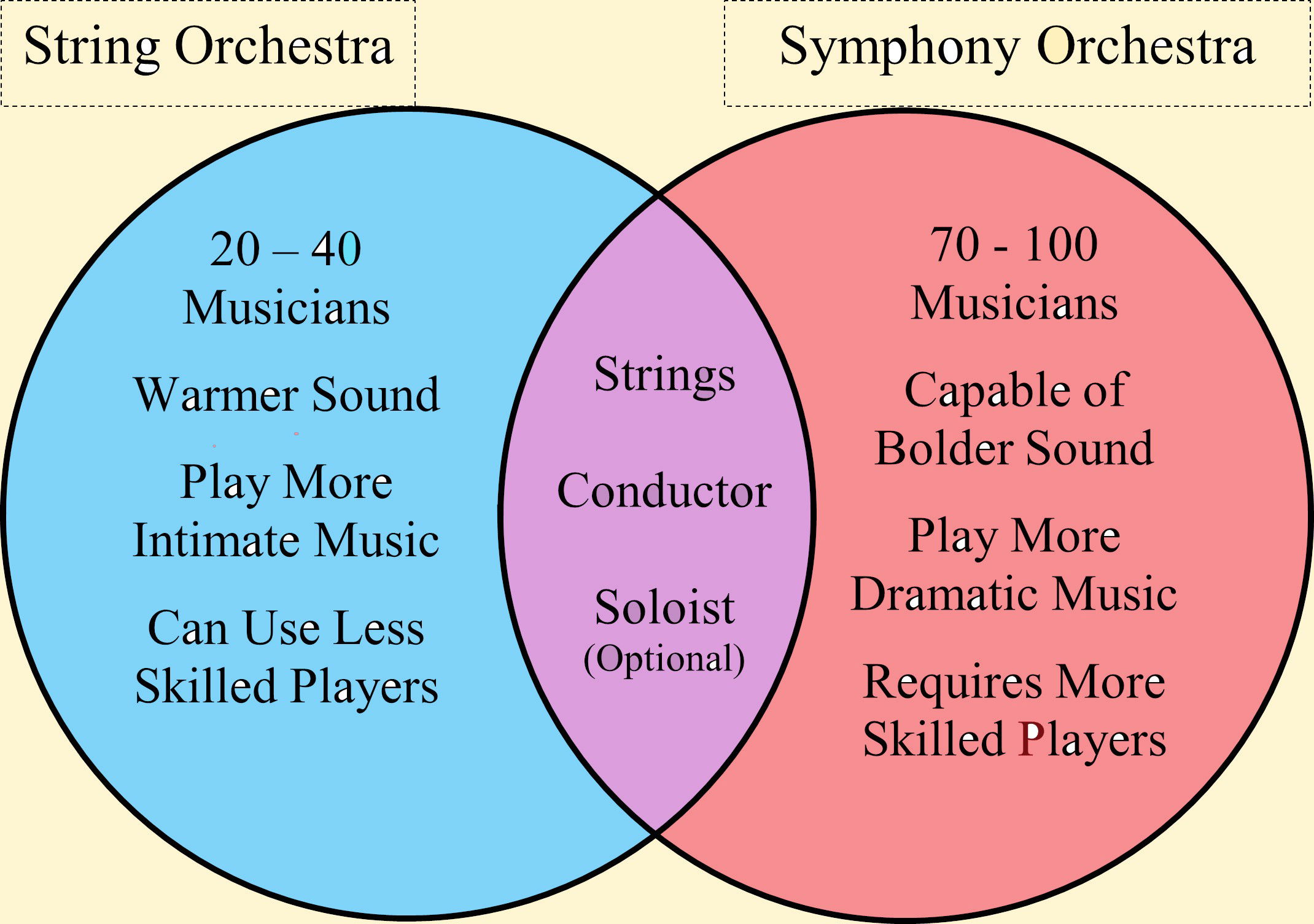
- Both orchestras have strings.
- Both orchestras have a conductor. This may sound like a given, but early orchestras of both types and chamber ensembles of various types do not have a conductor. They have someone to set tempo and start the group, but no one to maintain vigilance over them.
- Both groups may have a soloist, as in the case of a concerto.
Key Differences
- Number of Instruments – A string orchestra has only strings, while a full orchestra has strings, woodwinds, brass, and percussion.
- Sound and Tone – A string orchestra has a generally warm, flowing sound, while a full orchestra can be bold, dramatic, or even explosive.
- Size – String orchestras are usually smaller, with 20–40 musicians, while full orchestras can have 70–100 or more musicians.
- Music Style – String orchestras often play more intimate sounding pieces such as Baroque or chamber music, while full orchestras perform symphonies, film scores, and large-scale works.
- Skill Level of the Players – Symphony orchestras must have musicians that can play with a high level of competence. This is because not only are the pieces more complex in their melodies and harmonies, but the key in which a piece was written may or may not be one which the musician can play comfortably.
In general, string payers, especially student musicians, prefer sharp keys (from one to four) because those keys match the open strings on their instruments.
Wind players prefer flat keys (from one to three or four, depending on the level of the group) or the key of C. This is because of the layout of the keys on wind instruments.
From their creation, brass instruments, for whatever reason, have had a Bb as their fundamental tone.
Woodwinds have a different setup. From their creation, also for some unknown reason, they are more easily played in flat keys; the transition between notes in those keys is easier. For a deeper look at this concept, check out my article titled Why Student Concert Bands and String Orchestras Don’t Play Together.
In Conclusion, each ensemble has its own special flavor or color, and each has unique roles to fill. While full symphony orchestras have a wider assortment of instrument from which to choose to create almost any sound, mood, or expression, it is quite possible for a string orchestra to have its own variety of sounds, moods and expressions. Here are two very different pieces for String Orchestra form Salt Cellar Creations. The first is Golden Morning, a lush piece with a somber mood, using well-connected notes and phrases and close, dissonant harmonies. The other is The Awkward Marionette, a lively piece in 7/4 time that uses Pizzicato for emphasis and rhythmic interest.
Both types of orchestras are essential to the world of music, each bringing its own beauty and character. Whether you prefer the elegant harmony of a string orchestra or the grand majesty of a full orchestra, both offer something truly special.
Salt Cellar Creations understands the beauty and power that a String Orchestra can convey and the challenge that string orchestra directors face in choosing the best music for their ensemble. SCC and has a growing library of original works and arrangements to help meet the needs of string teachers and directors Find out more about what Salt Cellar Creations has to offer for String Orchestras HERE. Explore the available music HERE.
SCC can also compose an original piece for you or do a custom arrangement for you to allow you to showcase your group. There are two ways that this can be done; one is much more affordable than the other. CONTACT US for more information. And SCC is always looking for ideas of pieces to arrange or suggestions for original pieces.
We have sold music not only in the US but in Canada, the United Kingdom, France, Australia, New Zealand, Austria, Germany, and Kenya. Please visit the WEBSITE or CONTACT US to let us know what we can do for you!