What Kinds of Chords Are in Concert Band Compositions
The principal part of any musical composition is its melody, whether simple or complex. For centuries, the melody was the only element in a song. Even now, there are cultures, some here in the US, whose music consists of an unaccompanied melody.
If a primary melody has a second melody as its accompaniment, it still doesn’t produce actual chords, although a well-written composition with one or two voices can infer chords to a listeners ear. Here is a great example from Salt Cellar Creations. It’s a trumpet duet with no accompaniment. - https://www.salt-cellar-creations.com/brass-selections/ethereal-beauty-trumpet-duet
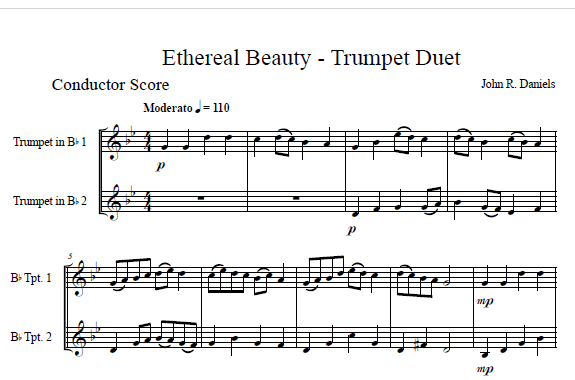
When you listen, you’ll notice that the combination of notes does indeed create the impression of chords in your ear. Also, the spacing (voicing) of the notes also gives a subtle impression of more or fewer instruments playing.
Now, if the melody has two or more notes accompanying it, there is a very good chance that there will be chords formed. The notes, of course, have to all be different.
So, if the melody is the principal part of a composition, the chord progressions form the harmonic foundation for it. This, of course, includes music written for concert band, which we will address in detail. The right chord progression can shape the mood, energy, and direction of a piece. In concert band music, composers often use a variety of progressions to create movement and emotion.
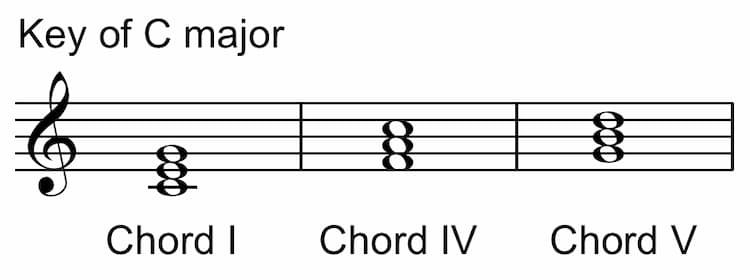
Here are some essential chord progressions that work well in concert band compositions. For the sake of those who may not be familiar with the Roman Numeral designations of chords, there will also be Nashville Numbers and a rendering in regular chord symbols in the key of C.
1. The I-IV-V-I Progression (1-4-5-1) (C-F-G-C) (Classic Cadence) One of the most common progressions in all of Western music, the I-IV-V-I progression is widely used in concert band compositions due to its strong sense of resolution. This progression establishes a clear tonal center and is particularly useful in marches, fanfares, and lyrical pieces. In any good piece for concert band, there are variations on this, or any other progressions for that matter, to keep it from being boring.
2. The I-V-vi-IV Progression (1-5-6m-4) (C-G-Am-F) (Popular and Emotional) This chord progression is commonly found in both classical and contemporary music. It has an emotional and uplifting quality that works well in lyrical or expressive concert band pieces.
3. The ii-V-I Progression (2m-5-1) (Dm-G-C) (Jazz Influence) Popular in jazz and big band compositions, the ii-V-I progression provides a smooth and sophisticated harmonic movement. It works well for ballads and swing-style pieces in concert band settings. You’ll notice that there are only three chords in this progression. That’s because it makes a great cadence, but will depend on some other progression before it. It may even be a good cadence for the example in number 2, above, since that example ends on the subdominant and must resolve to the tonic to make sense.
4. The I-vi-IV-V Progression (1-6m-4-5) C-Am-F-G) (Doo-Wop, 50s Rock and Roll, Romantic Feel, among others) This classic progression has a nostalgic and romantic feel, making it suitable for expressive and lyrical band pieces. It is often heard in ballads and slow movements. There is a slight alternate progression played as I-vi-ii-V (1-6m-2m-5) (C-Am-Dm-G). It offers a bit of color and variation.
5. The V-IV-I Progression (5-4-1) (G-F-C) (Plagal Cadence) Sometimes called the "Amen" cadence due to its use in church music, this progression provides a sense of closure and resolution. It is often used to end phrases or entire compositions. There are two variations of this cadence, both of which have been called Wagner cadences. One involves adding a minor 4 (V-IV-iv-I) (5-4-4m-1) (G-F-Fm-C). The other involves replacing the minor 4 with a half-diminished 2. (V-IV- iv7b5-I) (5-4-4m7b5-1) (G-F-Dm7b5-C)
6. The I-bVII-IV Progression (1-7b-4) (C-Bb-F) (Modal and Folk Influence) This progression, often found in folk and rock music, brings a modal sound to concert band music. It can easily be followed by either a dominant or tonic chord. Many other variations are possible. It can add a fresh, unconventional feel to compositions.
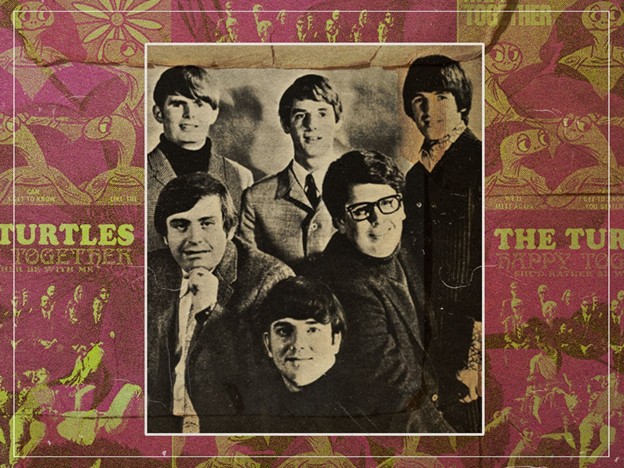
7. The I-bVII-bVI-V Progression (1-7b-6b-5) C-Bb-Ab-G) (Another Modal and Folk Influence) This progression has its roots as far back as the early 18th century. J.S. Bach used it in his Toccata and Fugue in D minor. The song “Happy Together” by the 1960s band “The Turtles” also used it.
8. The vi-IV-I-V Progression (6m-4-1-5) (Am-F-C-G) (Modern Pop Influence) This progression is widely used in modern pop music and can bring a contemporary sound to concert band compositions. It has a variation that is used about as widely as the original. It simply starts in the middle – I-V-vi-IV (1-5-6m-4) (C-G-Am-F). It’s amusing that this progression uses the exact same chords (relatively) as number 4, above. There is a warmth and familiarity about them that allows them to be used in a variety of ways.
Each of these progressions has a unique character and function, making them useful tools for concert band composers. By experimenting with different combinations, composers can craft engaging and memorable pieces that suit the ensemble’s needs. Whether writing a triumphant march, a heartfelt ballad, or a lively dance, selecting the right chord progression is key to shaping the overall sound and emotional impact of the piece.
All of the progressions above are based on consonant chords. But, those kinds of chords are “safe” and can get a bit boring if there isn’t some dissonance of some sort in the composition.
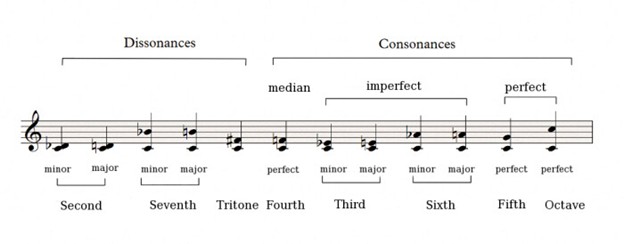
Here’s a short explanation of consonant and dissonant chords. Basically, consonant chords sound pleasing to the ear. They are considered to be stable, restful chords that don’t need to be resolved. They include intervals of a minor third, major third, perfect fourth and perfect fifth, and/or a full or flattened sixth. Seconds and sevenths of any sort contain tension that just doesn’t have the settled, stable sound that consonant chords have.
Dissonant chords sound unstable to the listener. They can be a simple major second or a flat fifth, or a series of minor sends or major sevenths. They can also be a significant chord in the piece, that is, a chord defined by melody and harmony and which is hard to miss. On the other hand, they can be a major or minor second in a melody or harmony that occurs only as passing tones.
It's interesting to note that for a time during the middle ages, the only intervals that were considered consonant were fourths fifths and octaves. During the time of J.S. Bach and G.F. Handel, thirds of both kinds were tolerated well and became part of the fabric of music that has been passed down to the present.
In concert band music, the use of consonant and dissonant chords shapes the overall character of a piece. Composers and arrangers carefully balance these elements to create interest, tension, and resolution. Understanding when and how to use consonant and dissonant chords effectively can greatly enhance the musical experience for both performers and listeners.
Consonant Chords: When and How to Use Them
Consonant chords create a sense of stability and resolution. These harmonies sound pleasant and are useful in the following ways:
1. Establishing Tonality:
- Consonant chords help anchor the piece in a key and provide a clear harmonic foundation. This is similar to what might be called a rhythmic consonance, in which it is necessary to establish the time signature in the listener’s ears before any variations can be made. Otherwise, the beat, tempo, and rhythms make no sense to the listener.
- Example: A concert band piece in C major may open with a C major chord to establish the key.
2. Providing Resolution: - After moments of tension, consonant chords offer a satisfying resolution.
- Example: A piece may build tension using a dissonant chord before resolving to a major triad. Dissonant chords ca be as simple as a suspend-four chord; and its resolution would be the movement of the four to the three. A Dsus4 would resolve to a D, either major or minor, depending on the intended movement of the progression.
3. Creating Warmth and Lyricism: - Sections featuring lyrical melodies often rely on consonant harmonies to support expressive playing.
- Example: A slow, emotional section may use rich, consonant harmonies to support the melody in the woodwinds. Eight or sixteen measures of a very consonant section will make any dissonance much more noticeable. If dissonances are used too liberally, they lose their punch.
4. Enhancing Clarity and Simplicity: - In marches, fanfares, and traditional band repertoire, consonant chords keep the harmony clear and direct.
- Example: A triumphant brass section might use simple major chords to maintain a bold, energetic sound. In cases of a march or fanfare, dissonances may even be considered “out-of-tune”.
Dissonant Chords: When and How to Use Them
Dissonant chords create tension and excitement. These chords contain intervals like minor seconds, major sevenths, or diminished fifths, which sound unstable and call for resolution. In a concert band, dissonance can be used effectively in the following ways:
1. Building Tension and Drama:
- Dissonant harmonies add intensity before resolving to a consonant chord.
- Example: In a dramatic moment, the brass section might sustain a cluster chord before resolving to a major triad. Sometimes, the chord doesn’t have to a static thing. It can be a series of moving tones, as in counterpoint.
2. Adding Color and Complexity: - Modern concert band music often uses dissonance to create unique textures.
- Example: Composers may layer different notes in woodwinds and brass to create rich harmonic colors, either as static chords or as counterpoint.
3. Creating Suspense and Mystery: - Darker sections of a piece, such as an introduction or a transition, can benefit from dissonant chords.
- Example: Low brass and woodwinds might sustain a diminished chord to evoke suspense before a sudden dynamic shift. Or, as in the case of the infamous them in the movie “Jaws”, the dissonance occurs as a short phrase.
4. Highlighting Emotional Contrast: - Dissonance makes moments of consonance more impactful by providing contrast.
- Example: A turbulent passage with shifting harmonies may suddenly resolve into a peaceful, consonant section for dramatic effect. As was mentioned above, if there are too many dissonant chords in a section, none of them will stand out. This may actually be the desired effect in some cases. The composer may use a mass of dissonances to make the consonant resolution even more dramatic.

Balancing Consonance and Dissonance Effective concert band pieces use a balance of consonant and dissonant chords to maintain listener engagement. Too much consonance may make the music predictable, while excessive dissonance can make it difficult to follow. Here are some things that good composers do to achieve balance:
- Use consonance to establish a clear tonal center.
- Introduce dissonance gradually or in short sections to avoid overwhelming the audience.
- Ensure that dissonant chords resolve naturally to maintain flow. Many pop tunes use suspensions without resolving them. This creates a sense of “non-centered” music, making the listener feel uneasy throughout the song since there is no definitive resolution.
- Experiment with layering consonant and dissonant harmonies for textural depth.
Salt Cellar Creations has a number of works for Concert Band that make conscious use of dissonance and appropriate resolutions. Those with the heaviest use of dissonance and consonant resolution are Baroquen Carriage, Morning Star Serenade, and Rockin’ Rondo .
There are other pieces that use dissonance and resolution well in the form of passings tones; they leave the impression of dissonant chords but don’t necessarily create any, except in passing. These include Carry Me Back to Old Killarney, and Hound of Heaven.
Of course, all of Salt Cellar Creations’ compositions and arrangements have their share of appropriate consonant and dissonant chords in them, in a variety of presentations.
Conclusion
Both consonant and dissonant chords are essential tools for composers and arrangers in concert band music. Consonance provides stability and resolution, while dissonance creates tension and excitement. When used thoughtfully, these harmonic elements bring depth and emotion to a piece, making the performance more compelling for both musicians and audiences alike.
Salt Cellar Creations understands the beauty and power that a Concert Band can convey and the challenge that Concert Band directors face in choosing the best music for their ensemble. SCC and has a growing library of original works and arrangements to help meet the needs of band teachers and directors Find out more about what Salt Cellar Creations has to offer for Concert Bands HERE. Explore the available music HERE.
SCC can also compose an original piece for you or do a custom arrangement for you to allow you to showcase your group. There are two ways that this can be done; one is much more affordable than the other. CONTACT US for more information. And SCC is always looking for ideas of pieces to arrange or suggestions for original pieces.
We have sold music not only in the US but in Canada, the United Kingdom, France, Australia, and New Zealand, Austria, Germany, and Kenya. Please visit the WEBSITE or CONTACT US to let us know what we can do for you!